Search This Blog

Nobel Prize Winners List 2016

Nobel Prize in Physics:
The Royal Swedish Academy of Sciences has decided to award the Nobel Prize in Physics 2016 with one half to David J. ThoulessUniversity of Washington, Seattle, WA, USA and the other half toF. Duncan M. Haldane Princeton University, NJ, USA and J. MichaelKosterlitz Brown University, Providence, RI, USA for theoretical discoveries of topological phase transitions and topological phases of matter.
Nobel Prize in Chemistry:
The Royal Swedish Academy of Sciences has decided to award the Nobel Prize in Chemistry 2016 to Jean-Pierre Sauvage University of Strasbourg, France Sir J. Fraser Stoddart Northwestern University, Evanston, IL, USA and Bernard L. Feringa University of Groningen, the Netherlands for the design and synthesis of molecular machines.
Nobel Peace Prize:
The Norwegian Nobel Committee has decided to award the Nobel Peace Prize for 2016 to Colombian President Juan Manuel Santos for his resolute efforts to bring the country’s more than 50-year-long civil war to an end, a war that has cost the lives of at least 220000 Colombians and displaced close to six million people.
Nobel Prize in Physiology or Medicine:
The Nobel Assembly at Karolinska Institute has decided to award the 2016 Nobel Prize in Physiology or Medicine toYoshinori Ohsumi (Japan) for his discoveries of mechanisms forautophagy.
Nobel Prize in Economic Sciences:
The Sveriges Riksbank Prize in Economic Sciences in Memory of Alfred Nobel 2016 was awarded jointly to Oliver Hart (United Kingdom) and Bengt Holmstrom (Finland) for their contributions to contract theory.

Latest Current Affairs September 2016 / Part 05

Q.1) Trade in Services Agreement (TiSA) is often in news. Consider the following statements with respect to TiSA
  1. It is a trade agreement currently being negotiated by 23 members of the World Trade Organisation (WTO), including the European Union
  2. It is based on the WTO’s General Agreement on Trade in Services (GATS)
  3. Only developed countries are part of TiSA
Which of the following statements is/are correct?
  1. Only 1
  2. 1 and 2
  3. 2 and 3
  4. All of the above

Q.2) The National Board for Wildlife has approved phase 1 of the Ken-Betwa river interlinking project. Consider the following statements with respect to same
  1. The project aims at providing water to the drought-prone Bundelkhand area
  2. As part of the project the government will have to divert thousands hectares of land including Panna Tiger Reserve in Madhya Pradesh
Which of the following statements is/are correct?
  1. Only 1
  2. Only 2
  3. Both 1 and 2
  4. None of the above

Q.3) Karnataka Government is not in favour of cloud seeding in areas facing deficient rain. Consider the following statements with respect to cloud seeding
  1. It is a method of enabling inefficient clouds to bring rain or enhance rainfall from a seedable cloud by introducing seeding material
  2. Cloud Aerosol Interaction and Precipitation Enhancement Experiment (CAIPEEX) is a technique to understand the rain formation in clouds and the impact of Randomized Cloud Seeding
  3. Silver iodide and dry ice is generally used for cloud seeding
Which of the following statements is/are correct?
  1. 1 and 3
  2. Only 1
  3. 1 and 2
  4. All of the above 

Q.4) The 52nd Amendment Act, 1985 provides for
  1. Disqualification of members of Parliament and state legislatures on the ground of defection
  2. Creation of All India Judicial Service
  3. An alternative scheme of devolution of revenue between the Centre & states
  4. None of the above

Q.5) Consider the below statements in regard to Railway Budget and General Budget in India:
  1. Department of Budget Affairs is responsible for the General Budget Preparation.
  2. The Railway Budget was separated from the General Budget in 1931.
  3. Bibek Debroy Committee has recommended discontinuance of a separate Rail Budget.
Select the correct statement/s from the codes given below:
  1. 3 only
  2. 1 and 3 only
  3. 2 and 3 only
  4. 1 and 2 only

Codex Alimentarius (Latin for "Food Code")

The Codex Alimentarius (Latin for "Food Code") is a collection of internationally recognized standards, codes of practice, guidelines, and other recommendations relating to foods, food production, and food safety.
 Codex Alimentarius
 
Its name is derived from the Codex Alimentarius Austriacus. Its texts are developed and maintained by the Codex Alimentarius Commission, a body that was established in early November 1961 by the Food and Agriculture Organization of the United Nations (FAO), was joined by the World Health Organization (WHO) in June 1962, and held its first session in Rome in October 1963. The Commission's main goals are to protect the health of consumers and ensure fair practices in the international food trade. The Codex Alimentarius is recognized by the World Trade Organization as an international reference point for the
resolution of disputes concerning food safety and consumer protection.
 
The Codex Alimentarius covers all foods, whether processed,semi-processed or raw.In addition to standards for specific foods, the Codex Alimentarius contains general standards covering matters such as food labeling, food hygiene, food additives and pesticide residues, and procedures for assessing the safety of foods derived from modern biotechnology. It also contains guidelines for the management of official i.e. governmental import and export inspection and certification systems for foods

World Breathing 90% Bad Air: World Health Organization

Nine out of 10 people globally are breathing poor quality air, the World Health Organization said Tuesday, calling for dramatic action against pollution that is blamed for more than six million deaths a year.
New data in a report from the UN’s global health body “is enough to make all of us extremely concerned,” Maria Neira, the head of the WHO’s department of public health and environment, told reporters.

The problem is most acute in cities, but air in rural areas is worse than many think, WHO experts said.
Poorer countries have much dirtier air than the developed world, according to the report, but pollution “affects practically all countries in the world and all parts of society”, Neira said in a statement.
“It is a public health emergency,” she said.

“Fast action to tackle air pollution can’t come soon enough,” she added, urging governments to cut the number of vehicles on the road, improve waste management and promote clean cooking fuel.
Tuesday’s report was based on data collected from more than 3,000 sites across the globe.
It found that “92 percent of the world’s population lives in places where air quality levels exceed WHO limits”.
The data focuses on dangerous particulate matter with a diameter of less than 2.5 micrometres, or PM2.5.
PM2.5 includes toxins like sulfate and black carbon, which can penetrate deep into the lungs or cardiovascular system.
Air with more than 10 microgrammes per cubic metre of PM2.5 on an annual average basis is considered substandard.
In some regions satellite data has been complemented by ground-level PM2.5 measurements, but in much of the developing world ground readings remain unavailable, forcing the WHO to rely on cruder estimates.
Despite these data gaps, Neira said the UN agency now had more information than ever about pollutants in the planet’s air.
Using both satellite and ground measurements “is a big step forward towards even more confident estimates of the huge global burden”, of dirty air, she added.

All India Radio – GST – Road Map and Economic Effects

GST rate will be harmoniser and standardiser
For several manufacturing products, the current prices are higher than whatever the GST rate is going to be. So the prices of manufacturing products will come down. But the prices of services are lower than whatever the rate is going to be, so the services rates will go up. Standardisation is all about paying more for one product and less for another and create a harmonising base.
Considering a GST rate of 18%, there will be uniform taxation on goods and services. The exempted products are petroleum products, tobacco and alcohol. But there will be products that will be exempted from 18% and taxed at a lower rate. It has to be realised that if too many products are exempted, it nullifies the intention behind GST, which is standardisation. Many states have argued and will argue that food products should be taxed at a lower rate because they are items of essential consumption. It is not yet known though what consists the list of exempted items. It is possible that food product GST rate might be as low as 4%. If too many exemptions
  • Impact of GST will be nullified
  • The Revenue Neutral Rate (RNR) goes up. If something is less than 18%, there will be other things which will have a higher rate.
If the tax system is streamlined, it enhances the resources to be spent on everyone.
International perspective
Most countries that have equivalent system as GST, don’t have a federal structure. India having a federal structure is expected to have three different GST rates.
The country that comes closest to having same GST structure as India is Canada. It took more than ten years to bring about the reforms in its existing GST structure.
GST in India

All India Radio – Launch of INSAT 3DR

ISRO successfully launched a GSLV-Mark II rocket carrying an advanced weather satellite-INSAT3DR to a geostationary transfer orbit around earth, from Sriharikota.

INSAT 3DR

It is advanced meteorological or weather observation satellite built by India to provide variety of inputs essential for accurate weather forecasting. It is equipped with three payloads- multi spectral imager, sounder and weather data relay transponder. INSAT 3DR also carries a satellite aided search and rescue transponder that picks up and relays alert signals originating from distressed beacons of maritime, aviation and land based users.
The INSAT-3DR joins KALPANA-1 and INSAT-3D meteorological satellites currently orbiting in space.

Significance
  • India’s capability in meteorological satellites has been good since 1980s. INSAT 3DR is advanced version of earlier weather satellites which will replace the earlier data by a fresh set of data thus making it more accurate.
  • The atmospheric infrared sounder prepares a vertical profile of temperature and moisture, thus creating a 3-D spatial distribution of these weather data. Such a picture helps in a much-improved analysis of weather phenomena and results in better forecasts.
  • India is an agricultural economy and thus good amount of agricultural inputs are required based on satellite technology for agricultural purposes.
  • Sea-surface temperature is also measured by these satellites. It is essentially required by the fishing industry because these sorts of temperature inputs allow them to know the better areas in the sea for catching fish. More accurate information will help India’s strong fishing industry.
  • It can recce of weather during low visibility period and during night. In night time, fog and very slow clouds usually come over the horizon and satellites systems are not able to monitor these as they did not have that sort of sensor capability. INSAT 3DR has higher sensors which allow them to monitor fog and low visibility.
Need of INSAT 3DR

All India Radio – SAUNI project- Phase 1

Background
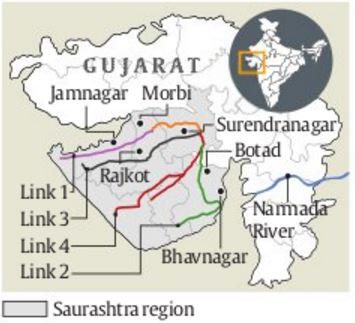
PM inaugurated the Rs. 12000 crore project SAUNI- Saurashtra Narmada Avtaran Irrigation yojana project.
SAUNI
  • SAUNI in local language means something for everyone, hence it will provide water to people of Saurashtra region.
  • It is not part of Narmada project but is based on it.
  • It aims to take water to water parched Saurashtra region to help in irrigation and providing drinking water facility.
  • The project has been constructed to deliver the excess flood water from Sardar Sarovar dam to 115 dams of the water scarce region through network of canals and pipelines.
  • This project was initiated in 2012. The entire project is expected to be completed by 2019.
This is an important project based on the new concept of pipeline network instead of open canal network. The dams store flood water and utilises that flood water for beneficial purpose. In this project, the excess water which otherwise would have gone to the sea will be diverted for irrigation and drinking purposes. A network of 1125 kms of pipelines will be present instead of open channels. The water through pipelines has many advantages-
  1. No seepage into ground
  2. No evaporation
  3. It can traverse adverse gradient
  4. There is no land acquisition as underground pipes are laid
Problems faced due to water scarcity
  • The water scarcity is the great impediment in economic development of any region as there cannot be meaningful development without water.
  • Saurashtra frequently faces draught like conditions.

The Union Public Service Commission (UPSC) is releasing the official notification for the Civil Services Preliminary Examination (CSE) 2025 today, January 22.

Interested and eligible candidates can check the notification on the UPSC’s official website, upsc.gov.in. According to the UPSC’s revised 2...